
What Is the Best Coating for Basement Floors in Grand Rapids?

The best coating for basement floors is a professionally installed epoxy and polyaspartic system. It seals against moisture, resists stains and impact, and is designed to last 15 to 20 years on West Michigan basement slabs. Premier Edge Concrete Solutions has coated basements across Grand Rapids and the surrounding communities.
Most homeowners start a basement floor project searching for the “best basement floor coatings” and end up overwhelmed by twelve options that all look reasonable on a Pinterest board. The real problem isn’t picking the most attractive finish. It’s identifying which floor types actually survive a Michigan basement. Once moisture, freeze-thaw movement, and the slab’s vapor pressure enter the picture, the list shortens fast. Here’s why epoxy ends up being the option that works.
Why West Michigan Basements Need More Than a Stain or Sealer

West Michigan sits on glacial soils with a high water table, especially in neighborhoods like Caledonia, Cascade, and parts of east Grand Rapids. Basement slabs absorb moisture vapor continuously, even when the finished floor above looks dry.
That vapor pressure is the single biggest reason most basement floor options fail here.
- Concrete stains penetrate the slab to add color but never seal it; moisture still pushes through, leaving white efflorescence rings and worsening hairline cracks.
- Surface sealers reduce absorption and work well on driveways and patios. In a basement, they don’t form a bonded film, so vapor still pushes through over time.
- Carpet and LVP can trap vapor coming up through the slab, leading to mildew, warped planks, and replacement well before their rated lifespan.
- DIY epoxy kits bond shallowly through acid etching and commonly peel within the first one to two years in basements with regular humidity.
The pattern is consistent: anything that doesn’t actively block vapor at the slab loses to a Grand Rapids basement eventually.
What Makes a Professional Epoxy System Different

A professional basement floor coating from Premier Edge isn’t a single product applied with a roller. It’s a five-step system designed to bond permanently and seal against moisture vapor. Each step solves a failure mode that DIY and lower-tier installations skip.
The 5-Step Process
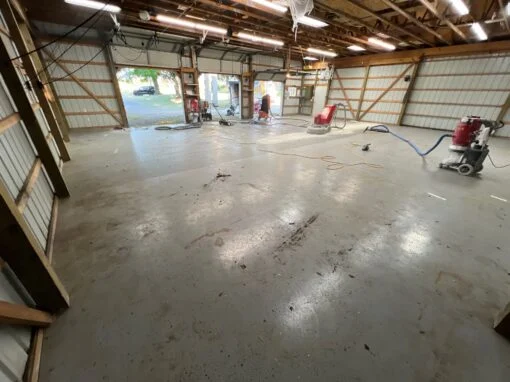
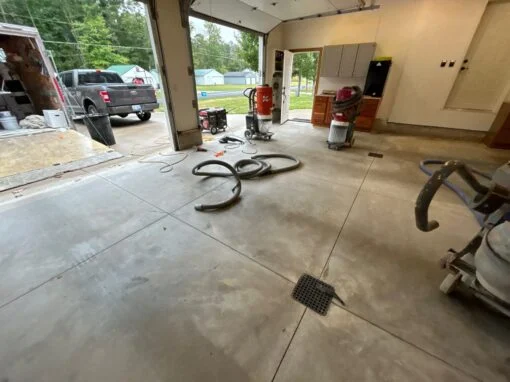
- Diamond grinding. The slab is mechanically ground to open concrete pores and create a Concrete Surface Profile (CSP) for permanent adhesion. Acid etching can’t match it.
- Moisture mitigation. Vapor transmission gets tested. If readings exceed thresholds, a moisture-mitigating primer goes down to block hydrostatic pressure from below.
- High-solids epoxy base coat. Penetrates the ground concrete profile and chemically bonds with the slab. This is the structural layer.
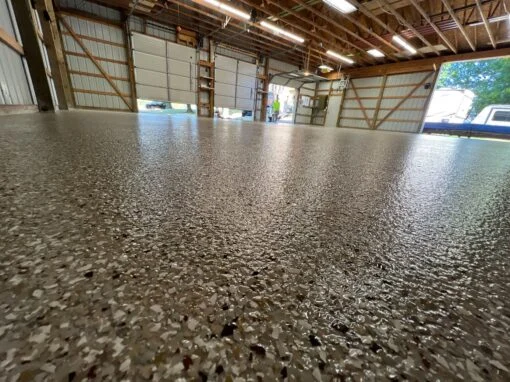
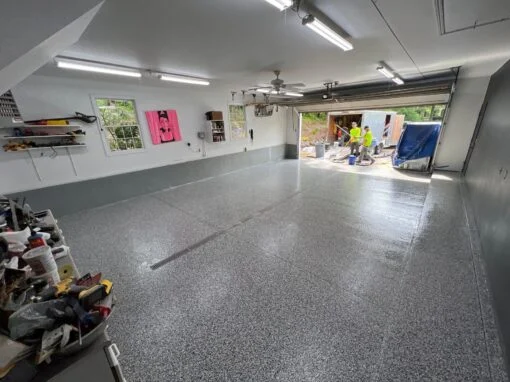
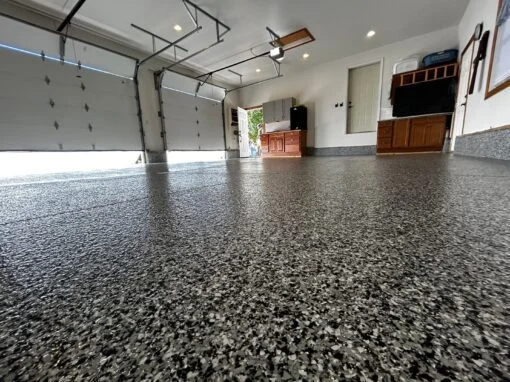
- Decorative flake broadcast. Vinyl chips scattered into the wet base coat add color, texture, and slip resistance. Excess gets scraped and vacuumed for a clean finish.
- Polyaspartic or urethane topcoat. The clear protective layer cures fast, resists UV, and handles routine basement cleaning chemicals without staining.
This is the same core process Premier Edge runs on commercial work: warehouse floors, restaurant kitchens, and spaces with even higher durability requirements than a finished basement.
What an Epoxy Basement Floor Holds Up To
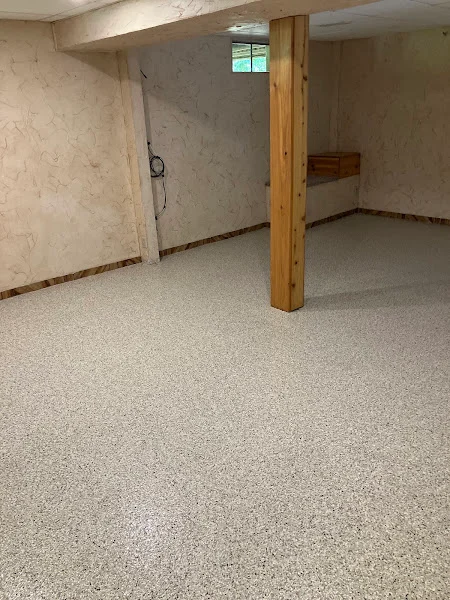
Once installed, an epoxy basement floor handles the full set of stresses West Michigan basements face. A Caledonia homeowner whose basement once had visible moisture stains, hairline cracks, and a musty smell now uses that space as a home gym and playroom. The floor stayed clean through a winter of muddy boots and equipment drag without showing wear.
That performance comes from how the system handles three specific stressors:
- Moisture vapor. The bonded epoxy and topcoat block vapor from reaching the surface. No more efflorescence rings, no more musty smell.
- Foot traffic and impact. The cured system handles dropped weights, dragged furniture, and kid traffic without chipping. It’s harder than the concrete underneath.
- Stains and chemicals. Spills wipe up before penetrating. Pet accidents, workshop oil, and laundry chemicals don’t leave permanent marks.
Properly installed epoxy basement floors carry manufacturer ratings of 15 to 20 years in residential use. Premier Edge backs every installation with a written lifetime warranty: in the unlikely event you’re not happy with the installation, we come back and fix it for free—and if we still can’t make it right, you don’t pay a cent.
What an Epoxy Basement Floor Costs in Grand Rapids

Professional epoxy basement floor coating in Grand Rapids typically runs $5 to $12 per square foot installed. For an 800-square-foot basement, that’s $4,000 to $9,600. A few factors move the number within that range:
- Slab size and condition. Larger basements bring per-square-foot costs down. Cracked, spalled, or salt-damaged slabs need more prep time.
- Moisture mitigation. Slabs that test above acceptable vapor levels need a moisture-mitigating primer. The added cost is the difference between a floor that lasts decades and one that delaminates in two years.
- Decorative finish. Standard flake colors run at the base price; custom blends, metallic finishes, and complex patterns add material cost.
The system carries manufacturer ratings of 15 to 20 years in residential use. Carpet and LVP in a basement often need replacement well before their rated lifespan, especially when vapor is present. The math favors a one-time epoxy installation in any basement seeing regular use.
Frequently Asked Questions
How long does a basement epoxy floor last in Michigan?
A professionally installed epoxy basement floor is designed to perform for 15 to 20 years in residential settings with normal foot traffic. At Premier Edge Concrete Solutions, we backs our basement coating installations with a lifetime warranty. Longevity depends on proper surface preparation, especially diamond grinding and moisture mitigation, which are the foundation for long-term adhesion in high-humidity basement environments.
Can I coat a basement floor that has moisture problems?
Yes, but the moisture must be addressed during installation. Professional installers perform moisture vapor transmission testing before coating. If vapor levels exceed acceptable thresholds, a moisture-mitigating primer is applied first to block hydrostatic pressure. Coating over untreated moisture often leads to delamination, bubbling, and eventual coating failure, sometimes within one to two years.
What’s the difference between DIY epoxy kits and professional installation?
DIY kits use water-based epoxy that bonds to the surface through acid etching, which opens fewer pores than diamond grinding. Professional systems use 100% solids epoxy that penetrates deeper and bonds mechanically to the ground concrete profile. The practical difference shows up within the first one to two years. DIY kits commonly peel in high-moisture basements, while professionally ground and coated floors maintain their adhesion for decades.
Get a Basement Floor That’s Made for the Long Haul

Every basement floor decision comes down to one question: will this surface hold up when the slab tries to push moisture through it? Stains, sealers, and floating floors mostly don’t. A professional epoxy and polyaspartic system does. Premier Edge has installed it across Grand Rapids basements and backs every job with a lifetime warranty.
Schedule a free basement floor estimate online or call (616) 816-2300 to talk through your slab’s specific conditions.